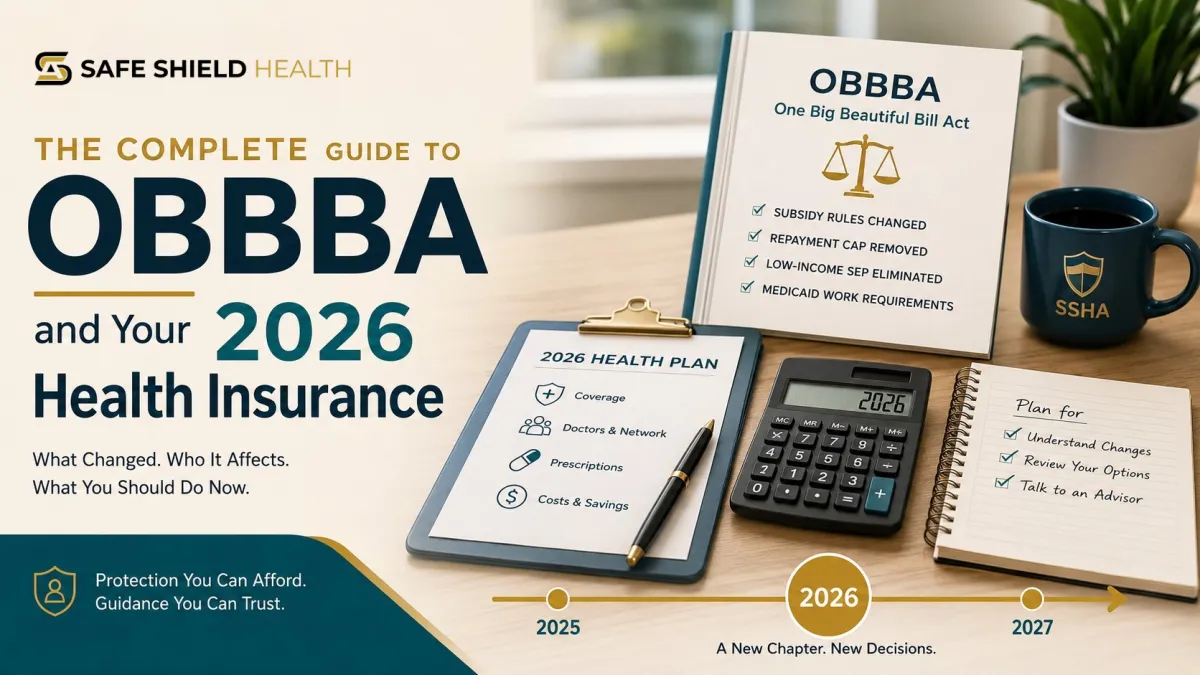
The Complete Guide to OBBBA and Your 2026 Health Insurance
"My subsidy just disappeared. I make too much for help, but not enough to pay this. How am I supposed to afford this?”
If any version of that sentence has crossed your mind in 2026, you are not alone, and you are not imagining things. The rules genuinely changed. A law called OBBBA changed them.
The One Big Beautiful Bill Act — signed into law on July 4, 2025 — quietly rewrote the financial mechanics of the Affordable Care Act, Medicaid, HSAs, and the way the federal government decides who keeps coverage and who loses it. Most of those changes took effect in 2026. Many of them showed up on people's premium bills before anyone explained what happened.
This guide explains every consumer-facing OBBBA provision in plain language, shows you what changed compared to the way things worked in 2025, and walks through what each change means for your household, your taxes, and your next enrollment decision.
It will not tell you OBBBA is good or bad. That is not the point. The point is to give you enough clarity to stop guessing, and then, if you want, to talk it through with a licensed advisor who can map your real options. Protection you can afford. Guidance you can trust.
Table of Contents
What Is OBBBA, In Plain English?
Why OBBBA Affects Your Health Insurance
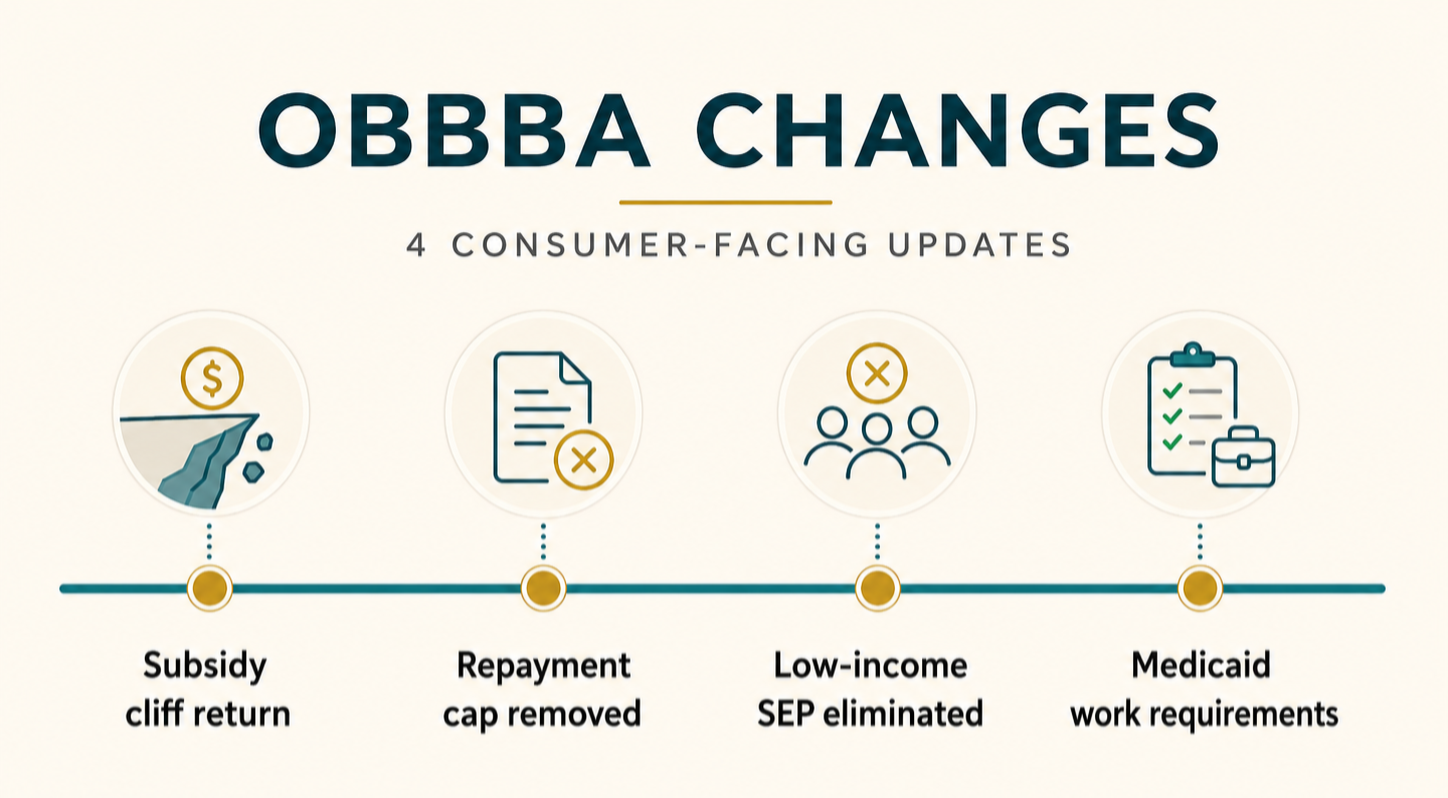
The 7 OBBBA Changes That Affect Your 2026 Coverage
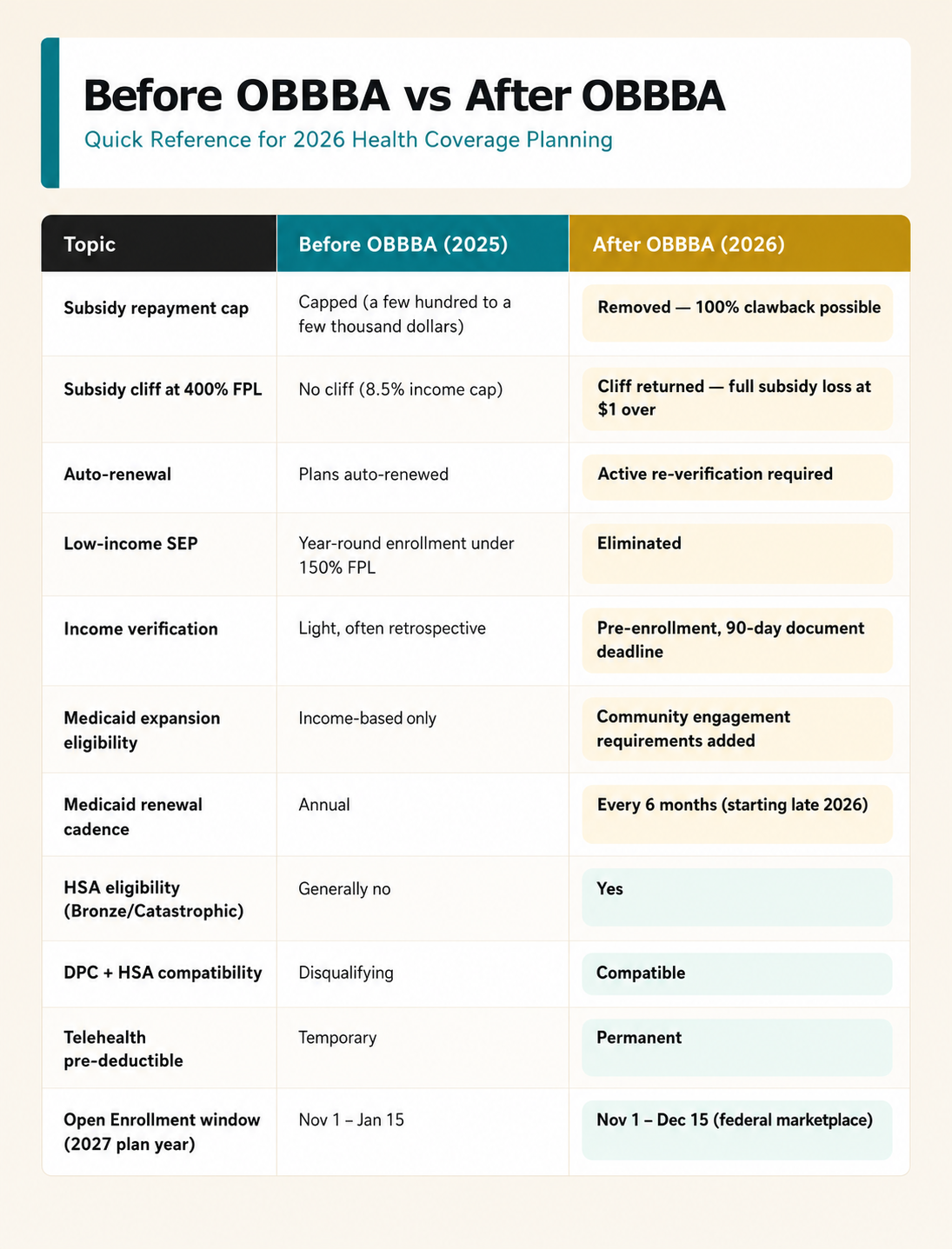
Before OBBBA vs After OBBBA: Quick Reference
Who Gets Hit Hardest By OBBBA
What You Should Do Right Now
Frequently Asked Questions About OBBBA
What Is OBBBA, In Plain English?
OBBBA — the One Big Beautiful Bill Act — is a federal budget law signed in July 2025 that restructured how Americans qualify for, keep, and pay for health insurance through the ACA marketplace and Medicaid. It removed the cap on subsidy repayments, ended automatic re-enrollment, added work requirements for Medicaid, and changed which household types can receive premium tax credits in 2026 and beyond.
That short paragraph is the answer most people are searching for. The rest of this guide explains what each piece of that means, who it hits, and what your real options look like.
OBBBA is not a single change. It is a stack of about a dozen changes, layered into one bill, that took effect on different dates across 2026, 2027, and 2028. Some of them affect almost everyone with marketplace coverage. Some only affect specific groups. A few are actually consumer-friendly — particularly the HSA expansions.
The law arrived at the same time the enhanced ACA subsidies introduced during the pandemic expired at the end of 2025. OBBBA did not extend those enhanced subsidies. That combination — the subsidy expiration plus OBBBA's new verification rules — is the reason so many 2026 ACA bills doubled, tripled, or arrived as a "Notice of Discontinued Coverage" instead of a renewal.
🔎 Why OBBBA Affects Your Health Insurance
If you have ACA marketplace coverage, are on Medicaid, contribute to an HSA, are self-employed and project your own income, or you are in your first five years of lawful U.S. residency, OBBBA changed something about your situation in 2026.
The Congressional Budget Office estimates roughly 10 million people may lose health coverage by 2034 because of the combined effect of OBBBA and the expired enhanced subsidies. Between January and April 2026, about 21% of HealthCare.gov enrollees lost coverage for non-payment — a dropout rate roughly twice the historical pattern.
Most of those people did not choose to drop their plans. They got hit with three things at once:
Their subsidy shrank or disappeared because the pandemic-era enhanced credits expired.
Their plan didn't auto-renew the way it used to, because OBBBA required active re-verification.
Their premium went up because carriers re-priced 2026 plans for a smaller, less-subsidized risk pool.
When you understand that sequence, the 21% dropout rate stops looking like a personal failure and starts looking like a policy event. That is the lens this guide uses.
👉 Check if your family qualifies for ACA assistance »
📈 The 7 OBBBA Changes That Affect Your 2026 Coverage
Below are the seven OBBBA provisions that affect the most households. Five of them increase cost or restrict access. Two of them actually expand consumer options. Both groups matter.
1. The Subsidy Repayment Cap Was Removed (The "Clawback" Rule)
What it used to do: If you got an ACA subsidy based on a projected income, and your actual income came in higher, you had to repay some of the subsidy at tax time — but only up to a capped amount. For most households, the cap was a few hundred to a couple thousand dollars.
🔎 What changed in 2026: OBBBA removed that cap. If you underestimate your income, even by a small amount, you may owe back the full subsidy when you file your taxes. There is no longer a ceiling on how much can be reconciled.
Who this hits hardest: Self-employed people, 1099 workers, freelancers, gig workers, commission-based earners, small business owners, real estate agents, and anyone whose income varies month-to-month. If you projected $48,000 of income for your 2026 application and you actually earned $72,000, the subsidy difference is yours to repay. No cap. No exception.
💡 Why this matters in 2027 (not just 2026): Most affected households will not discover the impact until they file their 2026 taxes in early 2027. That is the moment when "I had insurance all year" turns into "I owe the IRS $9,400."
2. The Low-Income Special Enrollment Period Was Eliminated
What it used to do: People earning under 150% of the federal poverty level could enroll in ACA coverage year-round through a special enrollment period (SEP). This existed to ensure the lowest-income households were never locked out of coverage by missing a four-week annual window.
🔎 What changed in 2026: That SEP is gone. If you missed Open Enrollment in late 2025, and you do not qualify for another SEP trigger (marriage, birth, job loss, qualifying move), you may have to wait until Open Enrollment 2027 to enroll in marketplace coverage. Private and short-term medical plans remain available year-round, with different rules.
💡 Why it matters: This removes the most common safety valve for lower-income households who fell out of coverage mid-year. It also means anyone on a tight budget should treat Open Enrollment as a hard deadline, not a flexible one.
3. Automatic Re-Enrollment Effectively Ended (Pre-Enrollment Verification)
What it used to do: If you had an ACA plan in 2025, your plan automatically renewed for 2026 unless you opted out. The marketplace re-pulled your information and continued your subsidy.
🔎 What changed in 2026: OBBBA added pre-enrollment verification requirements for anyone receiving premium tax credits. You now have to actively re-verify your income, household composition, and identity before your subsidized plan continues. Verification documents must generally be uploaded within 90 days, or coverage may be terminated. This is one of the structural reasons behind the 21% dropout rate.
💡 What you have to do: Log into HealthCare.gov (or your state marketplace), confirm household details, upload requested documentation, and confirm payment setup. Plans do not silently roll forward at the same subsidy anymore.
4. The "Subsidy Cliff" Returned
What it used to do: During 2021–2025, the enhanced premium tax credits (originally from the American Rescue Plan, extended by the Inflation Reduction Act) capped your marketplace premium at 8.5% of household income — even for households above 400% of the federal poverty level. There was no cliff. Help phased down gradually.
🔎 What changed in 2026: Those enhanced subsidies expired at the end of 2025. OBBBA did not renew them. The result is that the pre-2021 subsidy cliff returned — at exactly 400% of the federal poverty level. If your household income lands at $1 above 400% FPL, you may lose subsidy eligibility entirely. The 8.5% cap is gone.
💡 What this looks like in real numbers: A 60-year-old couple in many markets could see their annual premium go from roughly $5,100 (with 2025 subsidies) to $24,000+ (no subsidies) — a real example pattern reported across multiple states for 2026.
This is the change behind one of the most common 2026 phrases: "I make too much for help but not enough to pay this." It is structurally accurate. It is also the change that is most likely to be repaired by future legislation — but nothing currently in motion is set to do that for the 2026 plan year.
5. Medicaid Work Requirements (Community Engagement)
What it used to do: Medicaid expansion adults (income-eligible adults under 65 in expansion states) qualified based on income, not employment status.
🔎 What changed: OBBBA conditions Medicaid eligibility for certain expansion adults on the satisfaction of "community engagement" requirements — generally a defined minimum of work, volunteer, education, or job-training hours per month. Short-term hardship exceptions (hospitalization, etc.) apply, and people with serious medical issues or caregiving responsibilities are exempt. Implementation begins on a state-by-state rollout through 2026 and 2027.
💡 Why it matters: Even people who would meet the work threshold may lose coverage because of paperwork failures — missing a reporting deadline, having an attestation rejected, or being unable to upload documents within the required window. Past state-level pilots showed this is the dominant pathway to coverage loss under work requirement rules.
6. Medicaid Six-Month Redeterminations
🔎 What it changed: Starting December 31, 2026, states must re-determine Medicaid expansion eligibility every six months instead of annually. The intent is to keep enrollment current. The practical effect is doubled paperwork frequency and a doubled chance of falling out of coverage between renewals.
💡 What you should do if you are on expansion Medicaid: Watch your mail. Watch the email address on file with your state Medicaid agency. Confirm your phone number. Most coverage losses under six-month redetermination happen because a renewal notice was sent to an old address.
7. HSA Expansion — The Bright Spot
OBBBA also created consumer-friendly HSA changes that often get buried in coverage of the law:
Bronze and Catastrophic ACA plans are now HSA-eligible (starting 2026). Previously these were typically excluded.
Direct Primary Care (DPC) memberships are now HSA-compatible. Paying for a DPC membership no longer disqualifies HSA contributions, and the DPC fee can itself be paid with HSA dollars.
Telehealth coverage before the deductible is permanent for high-deductible health plans.
If you are healthy, self-employed, and prefer to self-direct your healthcare spending, the HSA expansion under OBBBA is genuinely useful. It is the one part of the law where consumer flexibility went up rather than down.
🎯 Who Gets Hit Hardest By OBBBA
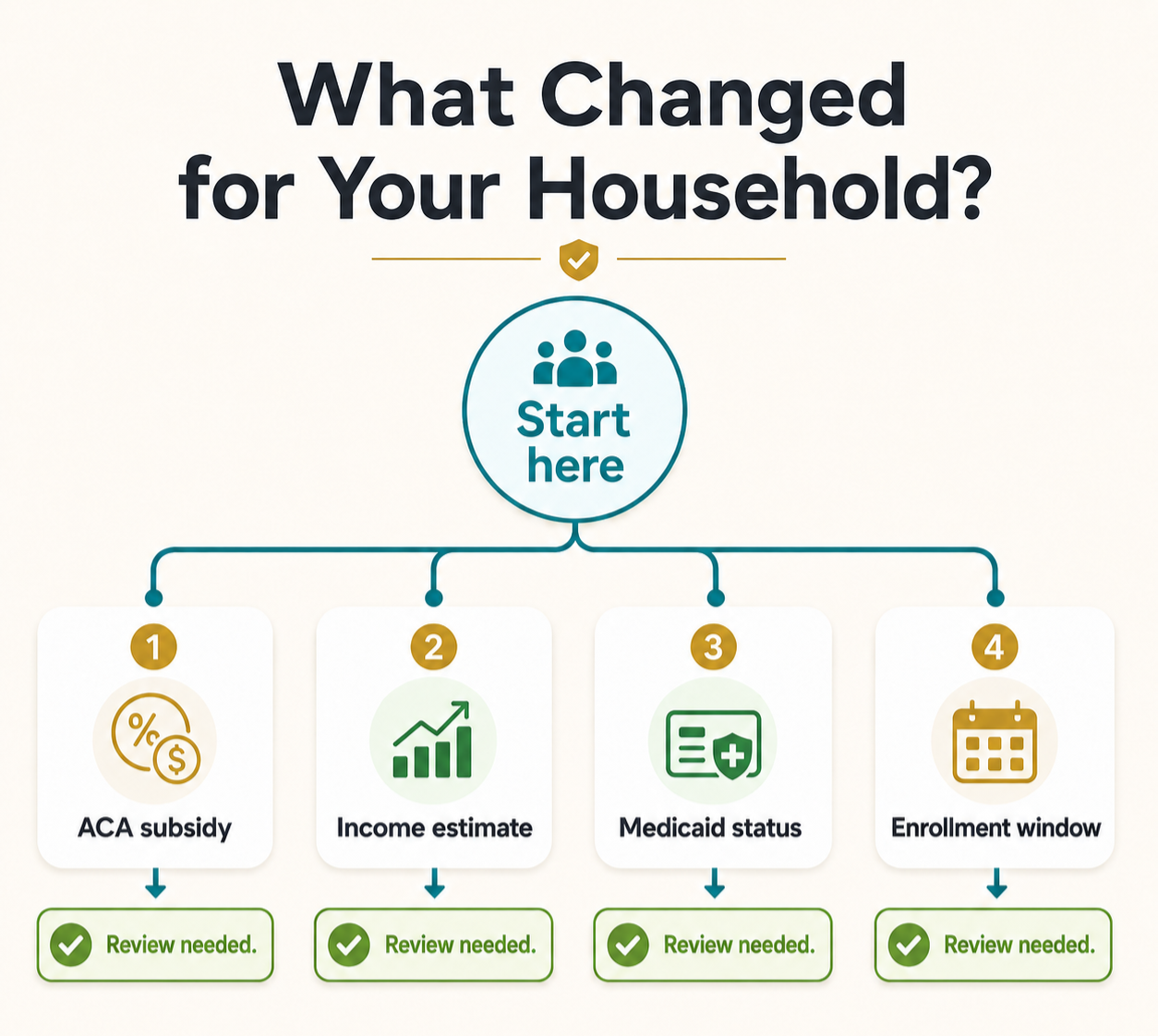
Not everyone is affected the same way. Five household types absorb most of the impact.
Self-employed and 1099 workers carry the biggest tax-side risk. Variable income plus a removed repayment cap is a financial planning problem, not a paperwork problem. Many freelancers will not feel this until April 2027.
Households just above 400% FPL — what financial planners call "the cliff zone" — lose subsidy eligibility entirely. A modest raise, a working spouse's bonus, or a one-time business income event can move a household from "subsidized" to "full freight" in a single tax year.
Pre-retirees ages 55–64 are hit hardest by the cliff in dollar terms. Health insurance is priced by age, and the gap between subsidized and unsubsidized premiums at this age is the widest. Pre-retirees in the cliff zone often see annual premium increases of $15,000 to $20,000+ for a couple.
Lower-income workers who missed Open Enrollment lose the year-round low-income SEP safety valve. If a job loss or income drop happens in March 2026, the ACA marketplace door is closed until Open Enrollment unless another SEP trigger applies.
Expansion-state Medicaid recipients face new paperwork frequency. Coverage loss under six-month redeterminations and work requirements is dominated by administrative failure rather than ineligibility.
If your household fits one of those profiles, OBBBA is not a background news story. It is a 2026 budget event.
What You Should Do Right Now
This is the part most articles skip. Here are the five steps a licensed advisor will walk through with you, in the order they matter.
At SSHA, we:
Audit your 2026 plan. Log into HealthCare.gov or your state marketplace. Confirm your plan is active, your subsidy amount, and any pending verification requests. If documents are pending, get them uploaded inside the 90-day window.
Check your income estimate against reality. If you projected $52,000 for 2026 and you are pacing toward $68,000, that is not a small variance under OBBBA anymore. It is a tax exposure conversation. Adjust your estimate now if you can.
Run the math on a private alternative. Private PPOs, short-term medical, fixed-indemnity plans, and ICHRA-funded options work differently from the marketplace. They are not always cheaper. But for variable-income households, they may carry less reconciliation risk. A licensed advisor can run a side-by-side comparison.
Confirm your Medicaid status (if applicable). Update your phone number and mailing address with your state Medicaid agency. Mark the next redetermination on your calendar. Set a reminder six weeks before, not six days.
Book a free 2026 Plan Review with a licensed advisor. Thirty minutes of conversation either confirms your current plan is the right fit, identifies a better-fit option, or maps an alternative you didn't know existed. There is no pressure to change anything. Outcomes vary based on eligibility, income, and household details.
🧠 Want to see a side-by-side comparison of your options? Click here »
📞 Talk to a Real Human Who Gets It
We’re parents. We’re caregivers. We’re health advisors who don’t believe in one-size-fits-all solutions. When you call SSHA, you get someone who:
Takes time to understand your family
Speaks plain language (and Spanish, too!)
Helps you build a plan that works—without pressure
📲 Call: (800) 868-6187 OR
📅 Schedule a consultation with a Safe Shield advisor »
💬 Frequently Asked Questions About OBBBA
When did OBBBA take effect?
OBBBA was signed into law on July 4, 2025. Most of its consumer-facing provisions — the subsidy cliff return, the repayment cap removal, pre-enrollment verification, and the elimination of the low-income SEP — took effect on January 1, 2026. Medicaid work requirements and six-month redeterminations roll out on state-by-state schedules through 2026 and 2027.
Does OBBBA repeal the Affordable Care Act?
No. The ACA is still federal law. OBBBA modified specific subsidy, verification, and enrollment rules within the ACA — it did not repeal the underlying framework. Marketplace plans, essential health benefits, pre-existing condition protections, and out-of-pocket maximums remain in place.
Will OBBBA cause my premium to go up?
It may. OBBBA itself did not directly set premium rates — those are filed annually by carriers and approved by state regulators. But OBBBA's combined effect (reduced subsidies, smaller subsidized risk pools, verification-driven dropouts) has put upward pressure on 2026 premiums in most markets. Many 2026 enrollees saw double-digit percentage increases compared to their 2025 plan. Actual impact depends on your state, age, household size, and income.
What if I underestimated my income on my 2026 ACA application?
Under OBBBA, the prior cap on subsidy repayments was removed. If your actual 2026 income comes in higher than what you projected, you may owe back some or all of the subsidy when you file your 2026 tax return in early 2027. There is no longer a ceiling on this. If your income is shifting upward, contact a licensed advisor to discuss whether updating your estimate now or restructuring your plan makes financial sense.
Am I still eligible for an ACA subsidy in 2026?
You may be. Subsidy eligibility in 2026 generally runs from 100% to 400% of the federal poverty level, with the 8.5% income cap (which extended help above 400%) no longer in place. A licensed advisor can confirm your eligibility based on household size, projected income, and state. Eligibility outcomes vary.
Do Medicaid work requirements apply in every state?
No. Medicaid work requirements under OBBBA apply primarily to adults covered under Medicaid expansion. Implementation is on a state-by-state schedule, with several states phasing rollouts across 2026 and 2027. People with serious medical conditions, caregivers, and short-term hardship cases (such as hospitalization) are generally exempt. Confirm your state's specific rules with your Medicaid agency.
Are there any positive OBBBA changes for consumers?
Yes. OBBBA expanded HSA eligibility to people with Bronze and Catastrophic ACA plans, allowed Direct Primary Care memberships to coexist with HSA contributions, and made pre-deductible telehealth coverage permanent for high-deductible health plans. For self-employed people who prefer to self-direct their healthcare spending, these are meaningful improvements.
What should I do if I lost my ACA coverage in 2026?
First, confirm whether your coverage was actually terminated and on what date — the dropout could be tied to non-payment, missed verification, or income-change confirmation. Second, check whether you qualify for a Special Enrollment Period (job loss, qualifying life event, qualifying move). Third, talk to a licensed advisor about replacement options including private PPO, short-term medical, fixed-indemnity, and gap plans. Coverage gaps can be costly — moving fast matters.
How OBBBA Changes the Conversation You Need to Have
Here is what is true about 2026: the rules of the marketplace shifted, the safety valves got narrower, and the cost of a wrong assumption — about your income, your enrollment status, or your subsidy — went up.
That does not mean the right move is panic. It means the right move is clarity.
A 15-minute conversation with a licensed advisor will land you in one of three places: your current 2026 plan is the right fit and you can stop worrying about it; a different plan structure would fit your situation better and we can map the switch; or you'll discover a path you didn't know existed. Either way, you leave the call knowing where you stand. No pressure to do anything. Eligibility and plan availability vary by household.
That is the conversation Safe Shield Health Agency exists to have.
Protection You Can Afford. Guidance You Can Trust.
📞 Call: (800) 868-6187
🛒 Compare 2026 Plans: SafeShieldHealth.com/compare-plans
✉️ Email: [email protected]
Safe Shield Health Agency is a licensed insurance brokerage. Plan availability, pricing, eligibility, and benefits vary by state, household, and product. This article is informational and does not constitute tax, legal, or insurance advice for any specific situation. Always confirm details with a licensed advisor.


