What Is OBBBA? A 5-Minute Guide for Confused Consumers
"I keep seeing 'OBBBA' in articles about my insurance going up. I don't know what it is. I don't have an hour to figure it out. Can someone just tell me what it means and whether I should worry?"
Yes. Here it is. Five minutes.
This guide is the short version. If you want the full breakdown later — every provision, every household type, what to do about each one — there is a longer guide linked at the bottom. But for right now, this is the version you can read on your phone while waiting in line.
The 60-Second Answer
OBBBA stands for the One Big Beautiful Bill Act. It's a federal budget law signed in July 2025 that changed how Americans get and keep health insurance starting in 2026. It made ACA subsidies harder to qualify for, ended automatic plan renewals, added work requirements for Medicaid, and removed the cap on how much subsidy money you might have to pay back at tax time. Some changes hurt consumers. A few (HSA rules) actually help.
That paragraph is the whole story. The rest of this guide explains the parts that matter for your household.
What Does OBBBA Stand For?
OBBBA stands for the One Big Beautiful Bill Act, signed into federal law on July 4, 2025. It's a budget-reconciliation package that bundled tax policy, immigration policy, defense spending, and a stack of healthcare provisions into one bill. The healthcare provisions are the part that's hitting your premium and your enrollment status in 2026.
You may also see it written as OBBB, OBBBA of 2025, or H.R.1. They all refer to the same law.
When Did OBBBA Take Effect?
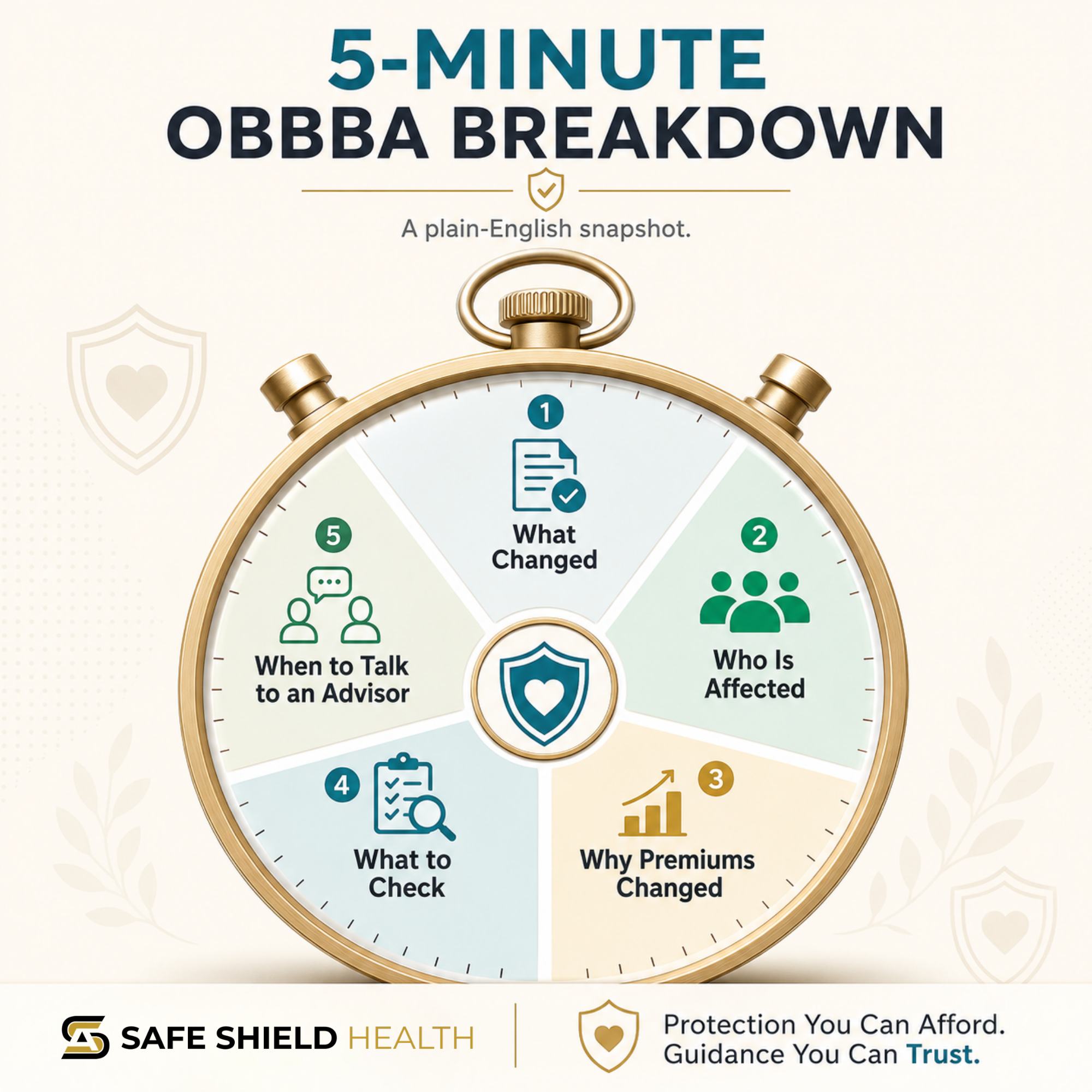
Most of OBBBA's health insurance provisions started on January 1, 2026. A few — like Medicaid work requirements and six-month redeterminations — phase in across 2026 and 2027 on state-by-state schedules. If your premium went up sharply in January 2026, or your plan didn't auto-renew the way it used to, you were almost certainly looking at OBBBA in action.
What Did OBBBA Actually Change?
Here are the five changes that affect the most households. If you read nothing else, read these.
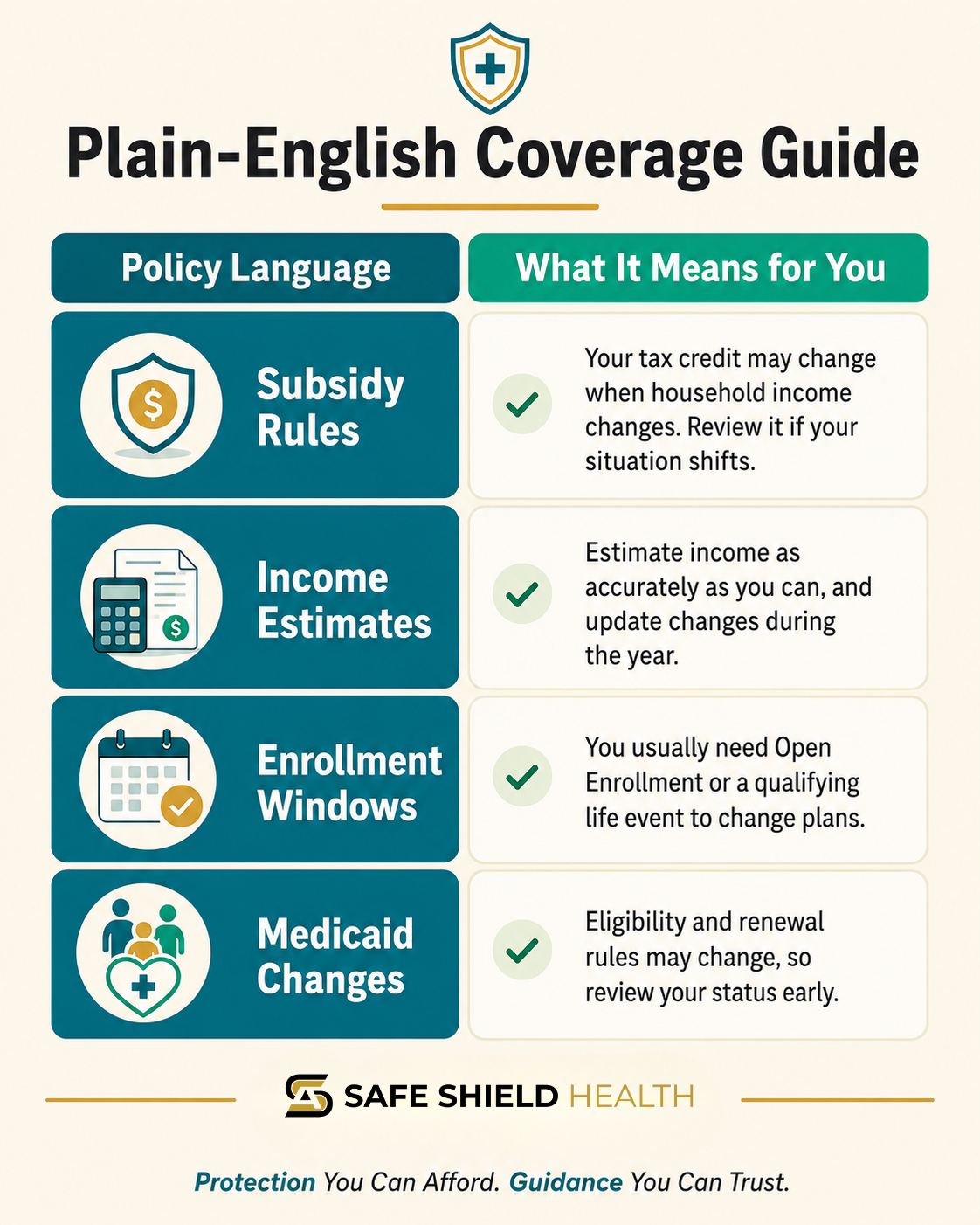
1. The subsidy repayment cap was removed. Before OBBBA, if you underestimated your income on your ACA application and got too much subsidy, you only had to repay a limited amount at tax time. That cap is gone. In 2026, you may owe back 100% of the excess subsidy. Self-employed people and anyone with variable income should pay close attention here.
2. Auto-renewal effectively ended. ACA plans no longer silently roll into the next year. You now have to actively re-verify your income, household, and identity before your subsidized plan continues. Verification documents typically need to be uploaded within 90 days, or coverage may be terminated. About 21% of HealthCare.gov enrollees lost coverage between January and April 2026 — and the verification rule is one of the biggest reasons why.
3. The subsidy "cliff" came back. The pandemic-era enhanced subsidies — which capped marketplace premiums at 8.5% of household income — expired at the end of 2025. OBBBA did not renew them. Now, if your household income lands above 400% of the federal poverty level, you may lose subsidy eligibility entirely. This is the change behind the phrase: "I make too much for help but not enough to pay this."
4. Medicaid added work requirements. Adults on Medicaid expansion may now need to document a minimum number of work, volunteer, education, or training hours each month. People with serious medical conditions, caregivers, and short-term hardship cases are generally exempt. Implementation varies by state. Past experience suggests most coverage losses under this rule come from paperwork failures — not from people who didn't meet the work threshold.
5. The low-income special enrollment period was eliminated. Previously, households under 150% of the federal poverty level could enroll in ACA coverage year-round. That door is closed. If you missed 2026 Open Enrollment and don't qualify for another life-event SEP (job loss, marriage, qualifying move), you may have to wait until late 2026 to enroll in marketplace coverage.
There are also a few consumer-friendly OBBBA changes worth knowing: Bronze and Catastrophic ACA plans are now HSA-eligible, Direct Primary Care memberships work alongside HSAs, and pre-deductible telehealth on high-deductible plans is now permanent.
Who Is Most Affected by OBBBA?
OBBBA doesn't hit everyone the same way. The households most affected are:
Self-employed people and 1099 workers (variable income + removed repayment cap)
Households just above 400% of the federal poverty level (lost subsidies entirely)
Pre-retirees ages 55–64 (highest absolute dollar increase from subsidy loss)
Adults on Medicaid expansion (new work and redetermination rules)
Lower-income workers who missed Open Enrollment (no more low-income SEP safety valve)
If you don't see yourself in those five groups, OBBBA's effect on you is probably modest. If you do see yourself in those groups, the effect is structural and worth a real conversation.
Why Is Everyone So Confused About OBBBA?
Three reasons.
First, the law is big — over 800 pages — and the healthcare provisions are spread across multiple sections instead of one clean chapter. Most news coverage focused on the political fights, not the consumer impact.
Second, OBBBA arrived at exactly the same time as the expiration of the pandemic-era enhanced subsidies. Those are two separate things, but they hit your premium together. Most people can't tell which change caused which dollar.
Third, the practical effects show up at three different moments: at enrollment (verification failures), in your monthly premium (subsidy reduction), and at tax time in 2027 (reconciliation surprises). By the time you understand the third one, the first two have already happened.
What Should I Do About OBBBA Right Now?
Three quick moves:
Confirm your 2026 plan is active and your subsidy is correct. Log into HealthCare.gov or your state marketplace. Look for pending verification requests. Don't assume your plan is fine just because you had one in 2025.
Check your income estimate against your actual income trajectory. If you're tracking above what you projected, the new repayment rules apply to you.
Get a second opinion from a licensed advisor. A 15-minute conversation will tell you whether your current plan still fits, whether a different structure makes sense, or whether you have alternatives you didn't know about. No pressure to switch.
🧠 Want to see a side-by-side comparison of your options? Click here »
📞 Talk to a Real Human Who Gets It
We’re parents. We’re caregivers. We’re health advisors who don’t believe in one-size-fits-all solutions. When you call SSHA, you get someone who:
Takes time to understand your family
Speaks plain language (and Spanish, too!)
Helps you build a plan that works—without pressure
📲 Call: (800) 868-6187 OR
📅 Schedule a consultation with a Safe Shield advisor »
💬 Frequently Asked Questions About OBBBA
Is OBBBA the same as Obamacare?
No. The ACA (Obamacare) is still law. OBBBA changed specific rules within the ACA — subsidies, verification, enrollment — but didn't repeal it. Pre-existing condition protections and essential health benefits remain in place.
Will OBBBA make my premium go up?
It may. The combined effect of OBBBA plus the expired enhanced subsidies pushed 2026 premiums higher in most markets. Actual impact varies by state, age, and household income.
Can OBBBA be reversed?
It's a law of Congress, so it would take new legislation to reverse. Some provisions (particularly the cliff) are politically active. Nothing currently in motion is set to change rules for the 2026 plan year, though.
Want the Full Breakdown?
This was the 5-minute version. If you want the complete walkthrough — every OBBBA provision, who gets hit hardest, what to do about each one — the longer guide is here: The Complete Guide to OBBBA and Your 2026 Health Insurance →
If you'd rather just talk to a person who already knows this stuff, that's why Safe Shield Health Agency exists.
Protection You Can Afford. Guidance You Can Trust.
📞 Call: (800) 868-6187
🛒 Compare 2026 Plans: SafeShieldHealth.com/compare-plans
✉️ Email: [email protected]
Safe Shield Health Agency is a licensed insurance brokerage. Plan availability, pricing, eligibility, and benefits vary by state, household, and product. This article is informational and does not constitute tax, legal, or insurance advice for any specific situation. Always confirm details with a licensed advisor.


